
Residents Find Independence as LifeQuest Shifts Focus
The purpose of life is a life with purpose
By Megan Luther
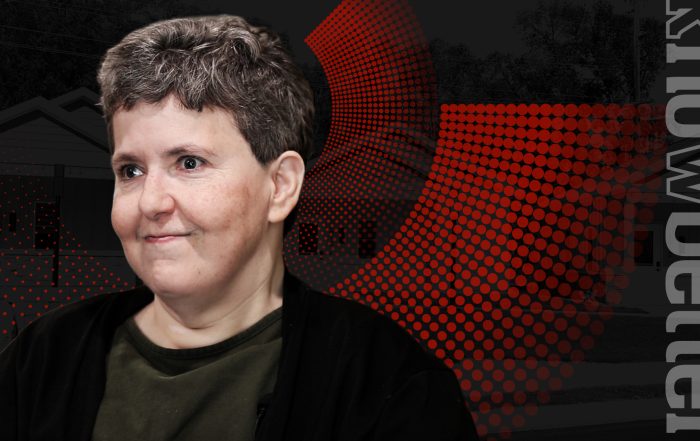
For the majority of her life, Cindy Montefering has been waited on, cared for.
Cindy, 53, lived with 11 others in a home owned by LifeQuest, a Mitchell nonprofit that serves people with intellectual and developmental disabilities.
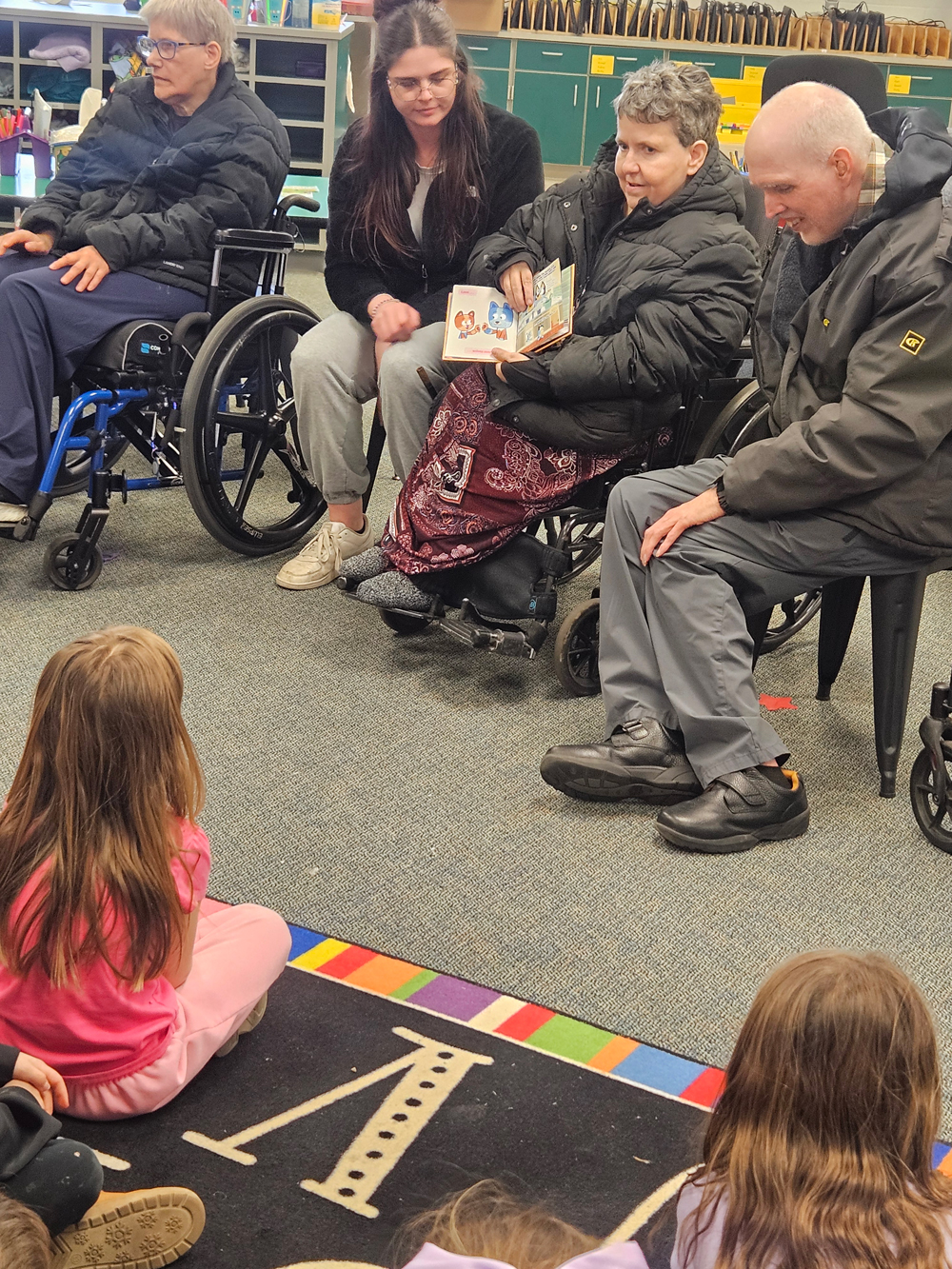
Cindy Montefering holds a book while she reads to kindergartners at Gertie Belle Rogers Elementary in Mitchell, S.D.
While Cindy was doted on by LifeQuest staff, something was missing. Instead of participating in life, Cindy was more of an observer.
Then a consultant flew in from out-of-state. He was there to help LifeQuest raise the bar, on how to no longer just care for residents, but support their independence. He pointed out that in Cindy’s group home the laundry room had a literal wall blocking Cindy’s wheelchair from accessing the machines. Even if she could maneuver, the washer and dryer were top-loading, too tall for her height.
“I wanted to be an independent woman,” Cindy said.
LifeQuest took down a wall to open the laundry space and installed a front-loading washer and dryer.
While many may groan that they have to do laundry, now Cindy gets to.
It was part of a big change for Cindy and other LifeQuest residents.
Transition
A Parkston native, Cindy lived most of her life in residential care starting at age 5, when she moved to the then-named Crippled Children’s Hospital & School in Sioux Falls. It’s now called LifeScape, a separate nonprofit.
Cindy moved to Mitchell in 1993, sharing a bedroom with a roommate in a LifeQuest group home.
She was quiet, lacked confidence and believed she wasn’t worthy, according to her friends and staff. She struggled to think she was capable. And Cindy could wield a sharp tongue, going from zero to 10 if she thought no one was listening.
While Cindy did some self-care like talking with a therapist, LifeQuest also evolved.
The nonprofit has been part of the Mitchell community since 1959 providing residential, vocational and community support services for people with developmental disabilities.
They now serve 170 people with about 200 employees in Mitchell. LifeQuest started imagining a new approach to care when they heard expert Tom Pomeranz speak at a conference. Tom, now retired, worked with individuals with developmental disabilities essentially his entire 58-year career, most recently as a consultant.
He’s seen vast changes over the decades: from the closing of state facilities where people were institutionalized, to residents living in community homes; from residents being forced to follow strict menus and mealtimes to being allowed to eat what they want and when. They are still given guidance and protective oversight, Tom said, but staff started asking residents “What would you like in your life? What are your desires?” It could be a tattoo or a piercing, Tom suggests, or maybe it’s something larger, like a new laundry room.
Tom has consulted with organizations in every single state except Hawaii. “I only go where I’m invited. No one’s ever asked.”
He ranks South Dakota as one the top five states in terms of quality of developmentally disabled services. He credits the advocacy organizations in the state and lists LifeQuest’s Executive Director Pam Hanna as one of the leaders. “Her agency is just spectacular. She’s brilliant. She’s excellent. And she really gets this stuff,” Tom said. He points out he’s retired so he isn’t complimenting Pam for a kickback.
LifeQuest hired Tom five years ago. He worked side-by-side with clients and staff, who evolved from caretakers to supporters. He flew in and evaluated the living spaces and made suggestions, such as removing that laundry room wall.
He focused on the concept he calls GEM, “Is it Good Enough for Me?” He asked the staff to put themselves in their clients’ shoes. If drool was staining a resident’s shirt, would a staff member want to be seen that way?
The training helped the staff change how they listen and respond to residents’ requests.
“No longer are we saying ‘no’, but ‘how, and if not now, when?’” said Pam.
At LifeQuest’s annual dinner meeting in August last year, Pam spoke in front of about 150 clients, staff and supporters.
“The purpose of life is a life with purpose,” she said. “We all need to feel we have a purpose. It makes us feel alive, valued and that we contribute to the betterment of others, and ourselves,” Pam said.
She tells the audience about Jenny Kunkel, a client, and Darla McGuire, a staff member, who often spend time chatting or going out for a pop. In the past, Jenny would stop by Darla’s office and ask to meet. Darla would look at her calendar and set a date.
Now Jenny is busy in the community, living life. Pam recounts a recent time Jenny stopped by Darla’s office.
“Darla threw out a time, Jenny said, ‘No, I have to work.’ Darla threw out another, Jenny said, ‘No, I’m volunteering at that time.’ Darla threw out another, and Jenny said, ‘No, I’m going out with my friends.’ This went on for a while. Finally, Jenny said, ‘I’ll have to get back to you.’ Darla is still waiting for Jenny to set up a time.”
The ask
About the time LifeQuest began working with Tom, Cindy started advocating for herself. “Maybe it’s the atmosphere, the excitement that got me into speaking up more,” she said.
Her first memorable ask was for an electronic lifting mechanism, so she could get herself out of bed.
Then came a big request: an accessible kitchen in the group home Cindy shared with others. Cindy wanted to cook her own meals.
“That oven was trash. And I used to get so mad when I couldn’t reach stuff. And I would feel so embarrassed asking someone, asking staff for help,” Cindy recalled.
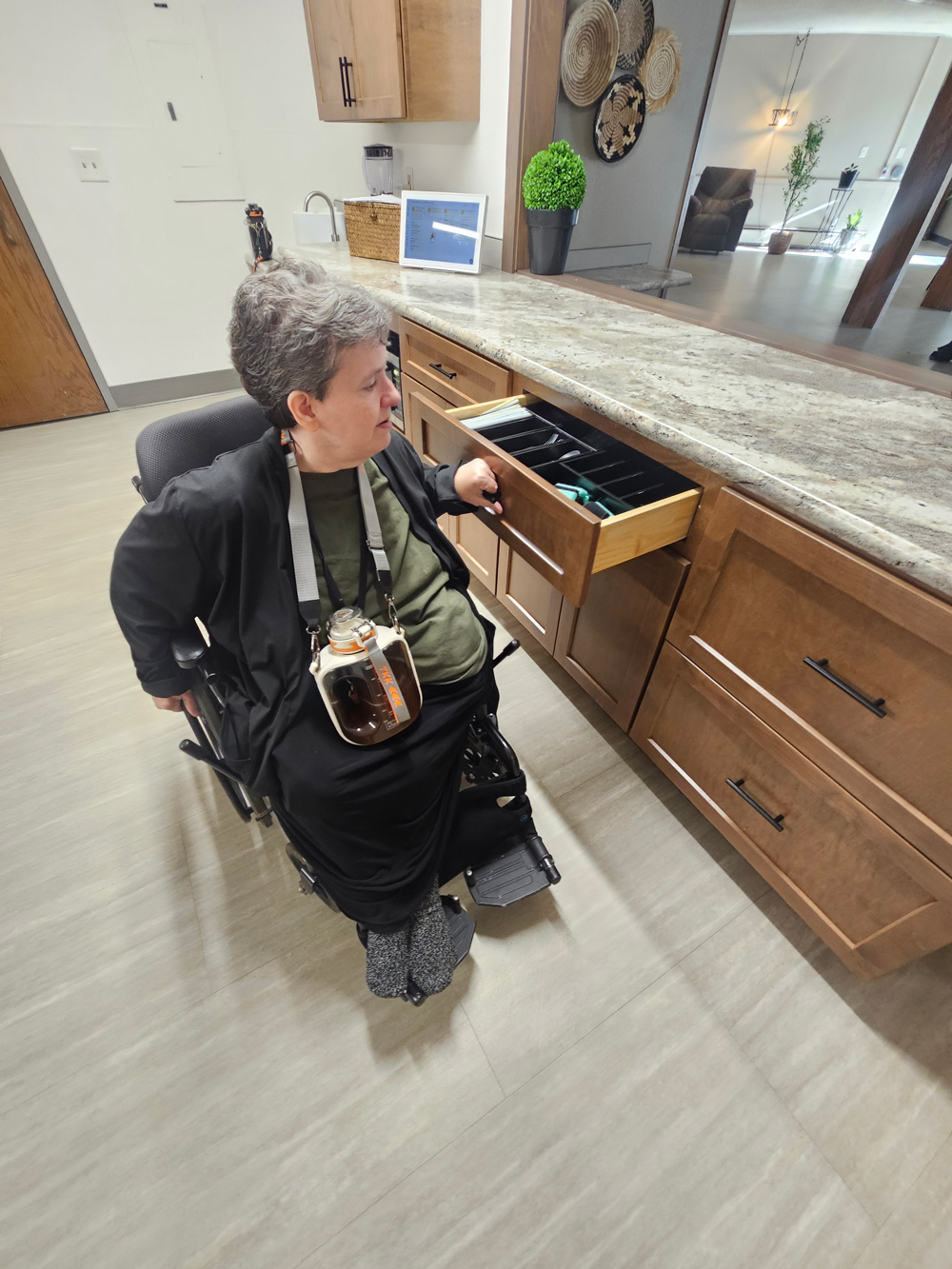
Cindy Montefering shows off the remodeled accessible kitchen she advocated for at her LifeQuest group home in Mitchell, S.D.
LifeQuest remodeled the kitchen, making it more wheelchair accessible. Afterward, Cindy loved to give tours of the home including pointing out the new microwave, which is now at her level.
Cindy says she’s living her best life now. And it’s not just the new kitchen or the front-load washer. Cindy found purpose and pride.
Her favorite thing to do is volunteer.
When she’s not greeting parishioners at church, visiting nursing homes or reading to kindergartners, LifeQuest staff takes Cindy to Parkston, her hometown to help at the Trojan Den, an organization that provides clothing, hygiene products, food and other resources for students and families.
“Cindy is one of our most consistent and dependable volunteers and an important part of our team,” said Colleen Mette, Trojan Den chair and art teacher for the Parkston School District.
Cindy doesn’t just fold clothes or organize donations, she connects with others.
“Could I ask you a question?” is Cindy’s favorite opening line. She’ll ask families, students and volunteers about school and their families.
“Those questions aren’t just small talk,” said Colleen. “They come from a genuine desire to know people and build real connections.”
It’s right in line with LifeQuest’s goal: For residents to be a part of their communities, side-by-side, not living in the shadows.
Cindy maintains the social schedule of a teenager. And at times, she can be hard to get ahold of. She frequently goes out for supper with friends Norm and Carol Schoenfelder. Cindy and Carol, a LifeQuest employee, met when Cindy moved to Mitchell. They bonded over jokes and now consider themselves family.
“She used to tell me she was going to take my man away. Go ahead and have him,” Carol jokes.
The threat might have something to do with Norm slipping Cindy money to play her favorite video lottery game.
More independence
If Cindy teases you, that means she likes you. And by that measure, Cindy loves Pam. Recently, they sat side-by-side at the group home’s kitchen table.
“How many years have we been together? Don’t you dare say too many,” says Pam.
Cindy smirks. “It feels like 100.”
“It feels like 200 to me,” Pam shoots back.
It’s actually 33.
Pam has watched Cindy grow, take control of her life and gain more independence.
It’s why Pam thought Cindy was ready for her own home.
In December, LifeQuest broke ground on its microhome village called “My Own Front Door” for residents who are ready to live more independently. The village, the first of its kind in the state, came from conversations LifeQuest staff were having with residents. It goes back to what Tom said: Beyond their basic needs, what are their desires?
Their dream, many told Pam, is to have a home of their own. “A place where they didn’t share a refrigerator, bathroom, or other areas with others,” Pam said. “A place where everyone who walked through their front door, was to there to see them.”
The village contains six homes and an office, which is staffed during the day.
At night, the homes rely on remote safety monitoring. Sensors alert if an oven has been on too long, or if a resident is up in the middle of the night. A microphone and speaker will allow residents and remote workers to communicate. On-site workers are just feet away in the group home.
Moving in
After eight months of construction, Cindy’s home is ready for her to move in. Cindy’s nervous, but excited about her first night in her own home. The August sun shines on the grass seedlings starting to sprout. LifeQuest staff are busy gathering up the last of Cindy’s things, her mattress, medications and food from her group home, carting it in a black foldable wagon to Cindy’s new white front door.
The 660-square-foot beige home even has a fully functioning kitchen. Cindy is parked next to the kitchen table.
Cindy’s older sister Charlene Montefering walks in with plastic bags.
“You want to know what’s in them bags?” she asks Cindy. She pulls out a comforter with matching sheets and curtains. They’re purple, Cindy’s favorite color.
“Oh my gosh! Oh my gosh!” Cindy squeals.
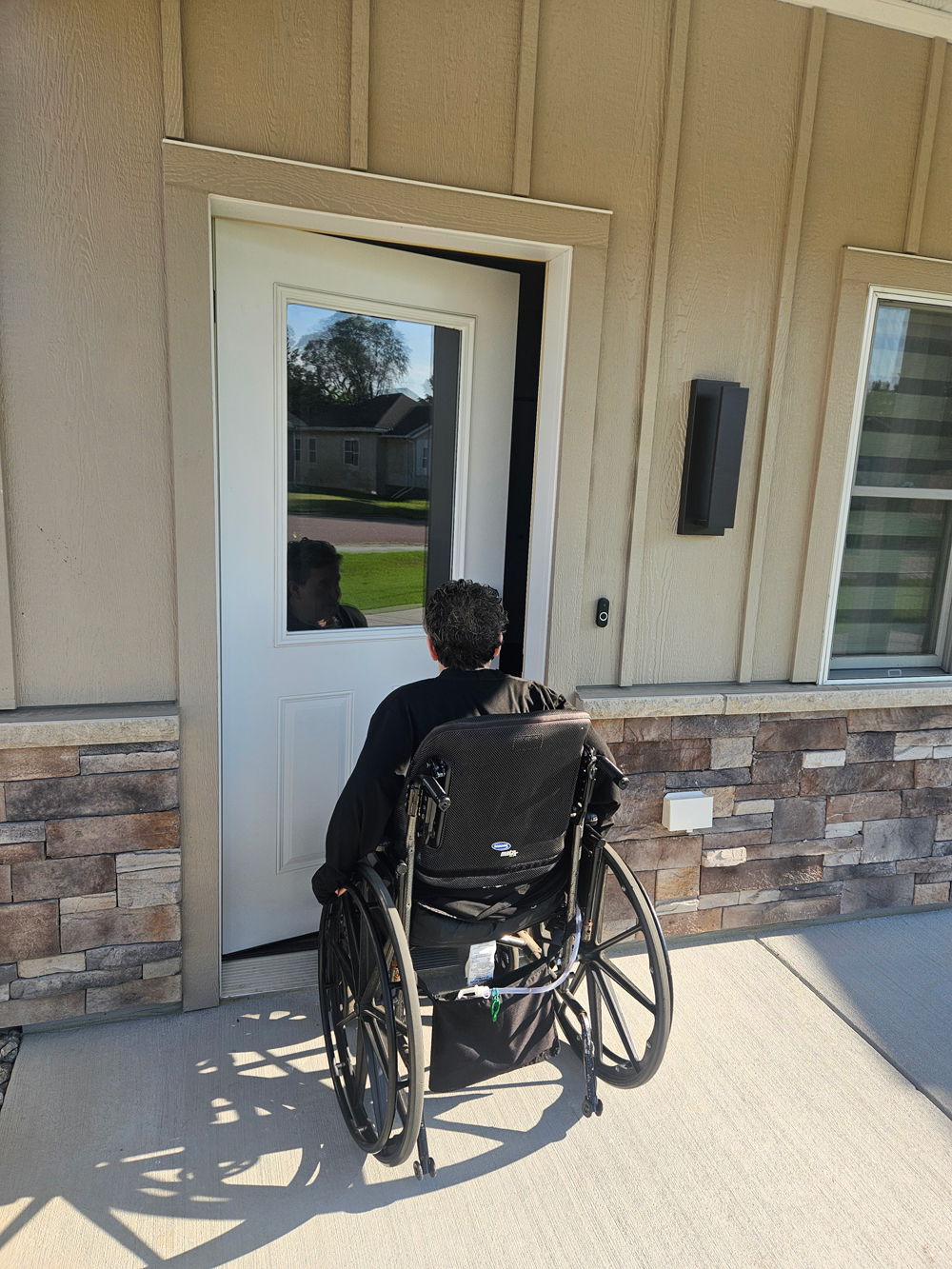
Cindy Montefering wheels through the front door of her new home in Mitchell, S.D.
Besides her new home décor, which Cindy picked out, she says she’s most looking forward to greeting guests at her new front door. “‘Hi and welcome to my new little mansion,’” she practices.
And no mansion would be complete without a laundry room. Cindy’s is set up with a new laundry machine: it’s at her level, a front-loading, all-in-one model that washes and dries.
Cindy says she loves it because it’s her washer in her own home — one she no longer has to share with anyone else. But she would rather not fold her clothes – even though she gladly does it for others when she volunteers at Trojan Den. “It’s going to be a task, but I can do it.” Indeed she can, when she feels like it.
With her own place, Cindy says she’s going to take a break from asking Pam for anything else. “I think I’ll be quiet just for a little while,” she smirks. Maybe a month.
But she already has a wish list: At the top are new vans. Last year, LifeQuest bought a minivan that allows wheelchair users to sit in the front passenger area. Cindy wants more vehicles that way.
There’s a reason we rushed to call dibs on the front seat as kids. To Cindy, it makes her feel “more in charge and the queen.”
And now her majesty reigns over her own castle.
Megan Luther, a lifelong storyteller, has called Mitchell home for more than 30 years.